

Before getting into it
They say you learn from your mistakes. In the mountains, depending on the activity, I think sometimes you don’t learn at all, basically because you take a massive fall, you die, and then you don’t learn anything because you’re dead. End of story. This day would go down as the most difficult one, and the one with the most tension in the group. And although we all learned quite a lot, we came close to not learning anything at all.
From the shelter to the first couloir
We woke up as planned at 5 in the morning. Choba’s alarm went off with a fairly pleasant melody, but by then I was already awake. Just like Druida can’t sleep when a demanding, exciting route is coming up, one that’s going to require a lot of concentration, I had been wide awake since 4. On top of that, I had a sudden need to pee at around 2 in the morning, which gave me the chance to set up my insta360 to record a night timelapse of the full moon. So, yeah, a proper sleepless night.

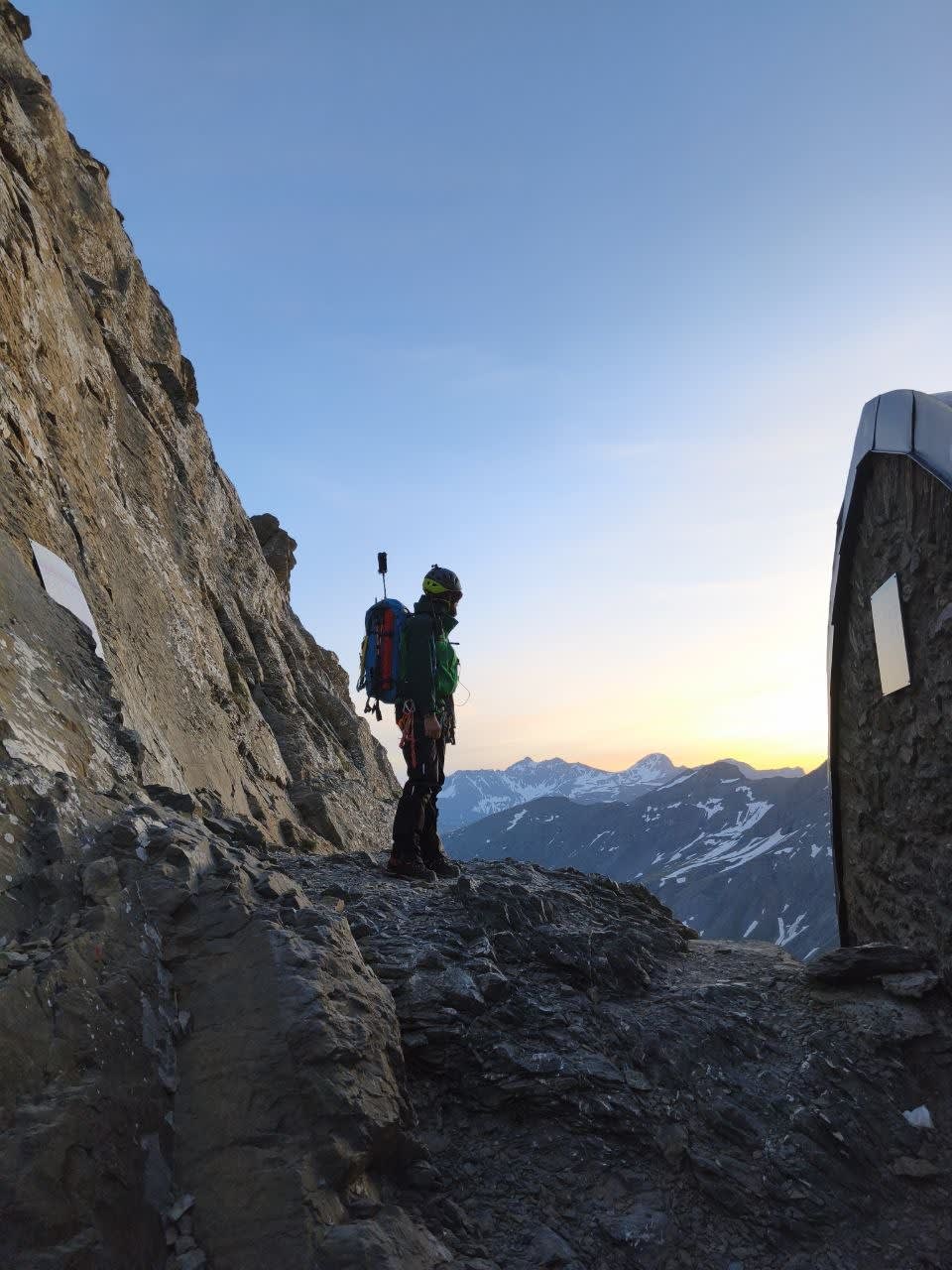
As if we had springs in our backs, we sat up and slipped out of our sleeping bags like ninjas so we wouldn’t wake Gerard, or Sergio, who was sleeping with earplugs in the bunks above. Honestly, I thought it was amazing how we did everything in complete silence: packing the sleeping bags, getting breakfast ready… well, not everything, because the bangs from the shelter door every time it opened and closed sounded like the New Year’s Eve chimes at Puerta del Sol.

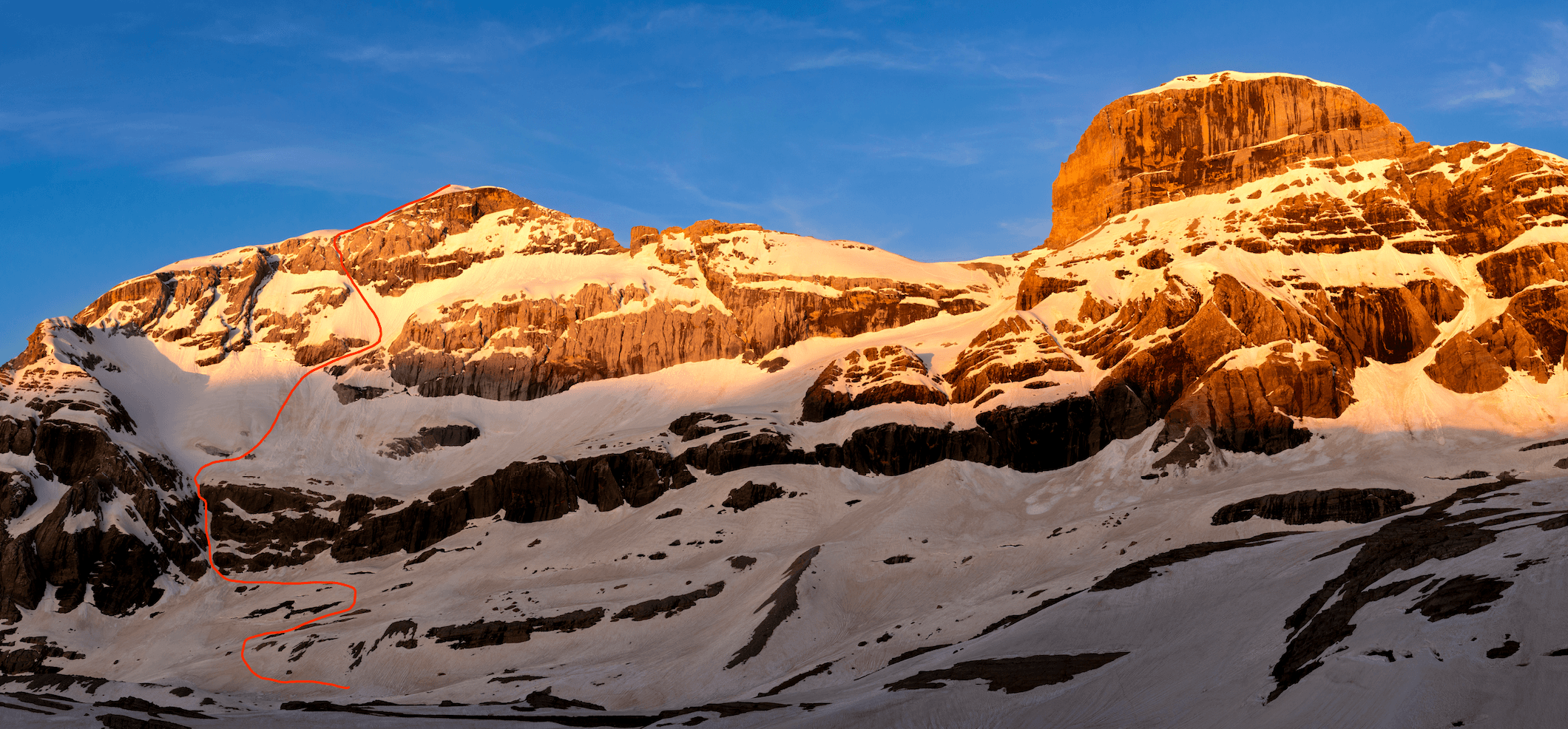
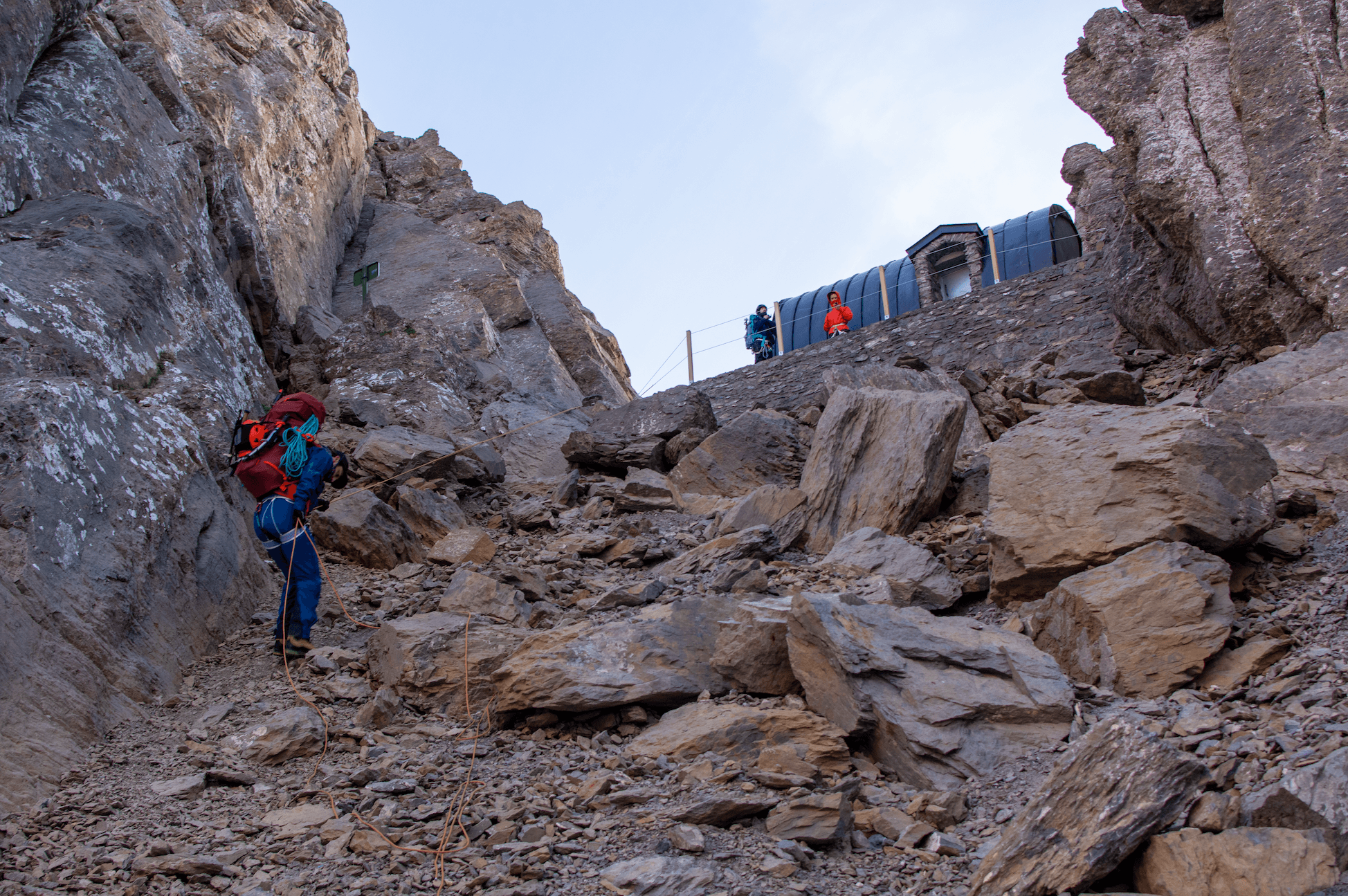
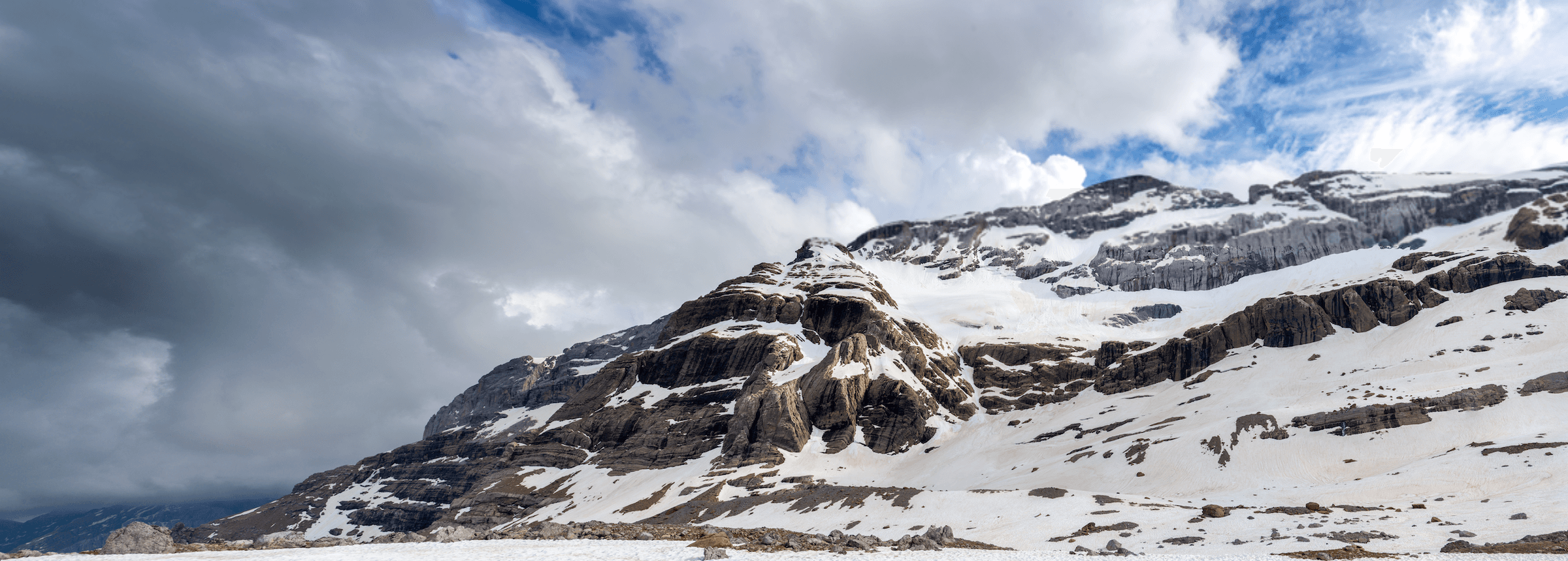
Once we had eaten breakfast and got dressed, the day woke up cold and windy, but clear. The sun was hitting the north face of Perdido and the Cilindro — our objectives for the day, if everything went well — which looked like anything but north-facing. Not a great sign, we thought, but well, a lot could change by the time we reached the couloir. Since none of us really fancied going down the murderous path used to get up to and down from the shelter, we set up a 30-metre rappel and skipped a good chunk of the descent much more comfortably. Once we were all down, we put on our crampons and began the approach.

We had to make a small adjustment with the radios. Apparently, I was always communicating on a channel and subchannel, while the others were on a channel and broadcast mode, so we couldn’t always hear each other properly. As we skirted around the Ibón de Marboré, we got them sorted and checked that everyone could talk to everyone else. The next stop was to collect water from the same waterfall where we had filled up the day before, and we could already see that the thaw had changed our water sources quite a bit. So we stopped at the same one, but a little higher up, where the access was easier and nobody had to get soaked.
The approach: snow, seracs and the first doubts
We were ready. We had water, we had crampons, we had ice axes, ropes, and motivation. A lot of motivation. And so we began the final approach. Joshua and I, who were a bit ahead, started discussing how to avoid a direct climb up to the entrance of the first couloir, and we saw that with a couple of zigzags here and there we could avoid going straight up like animals. Diego was in charge of breaking the first trail of the day after we pointed out roughly where we thought it made sense to go, and once he agreed, he started stamping the snow for us. Having Lúpulo go first is an absolute gift. He has an innate ability to sink into the snow up to his waist, so when Diego goes through and doesn’t sink, the rest of the rope team knows they won’t sink either.

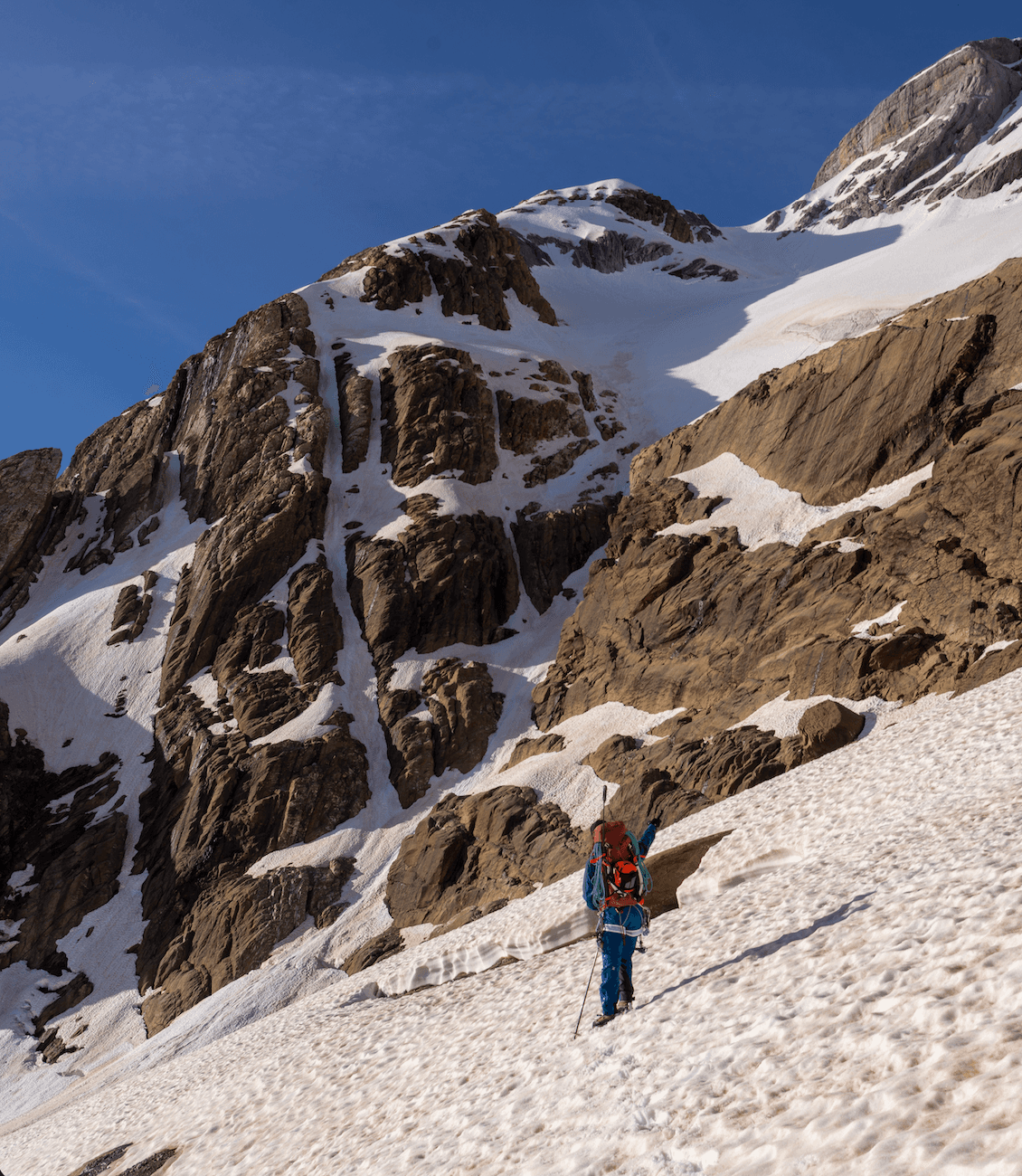

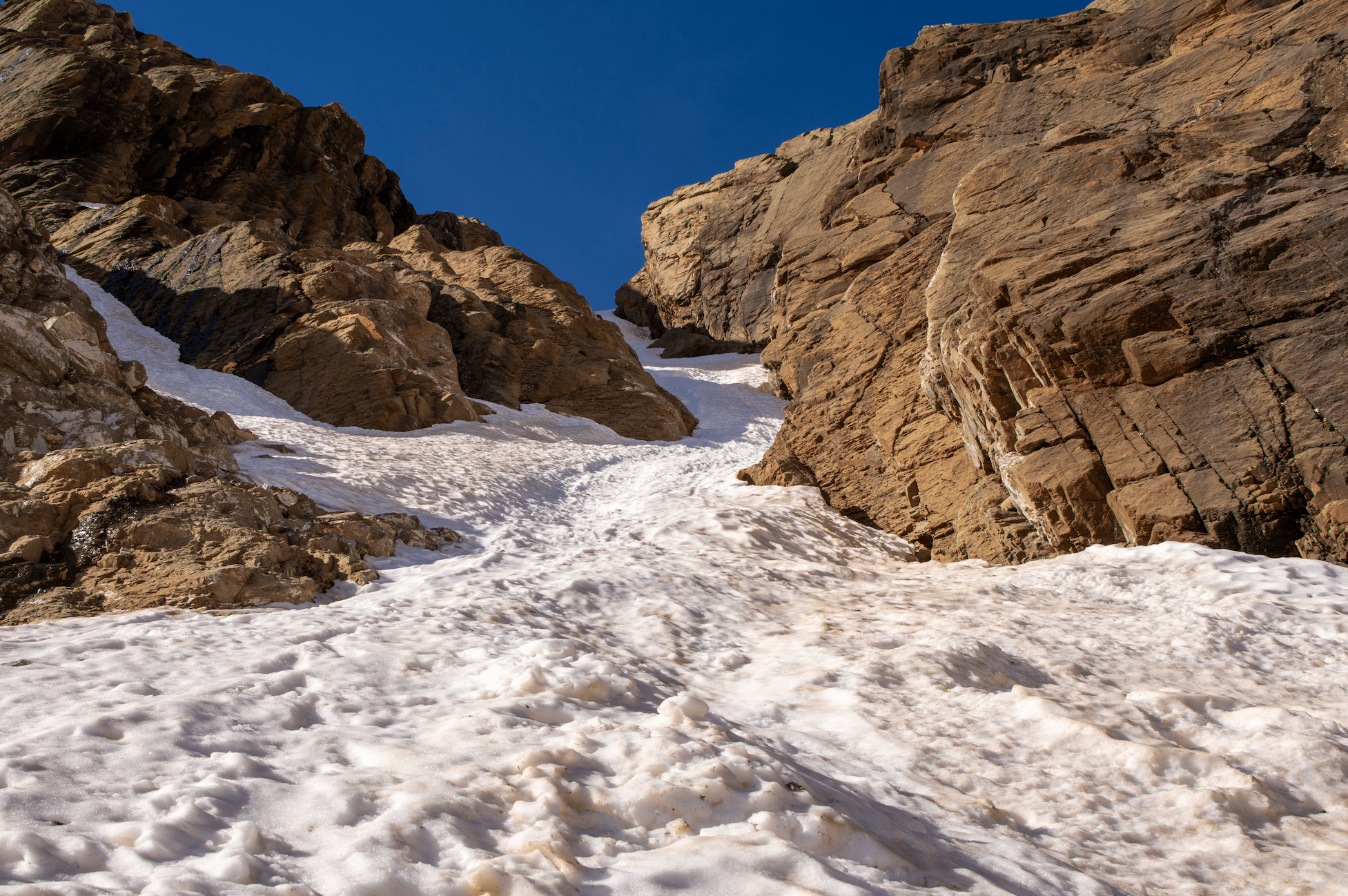
About an hour later we were at the entrance to the first couloir, and it was time to swap poles for ice axes and put our helmets on. The snow was, for our taste, quite a bit better than we expected, and we didn’t see the need to rope up, so we started climbing calmly, making a good track, with no rush, the four of us in a line. The first couloir was amazing: not too wide, not too narrow, like a corridor rising at a constant angle, with little streams of water along the sides and the odd hole opened by the thaw where, if you stepped into it, you could easily stand upright and not touch the bottom. Although the sun was hitting hard and happily, we were in the shade, and when we turned around we could see Tucaroya shelter getting smaller and smaller. I was in front, taking photos here and there.

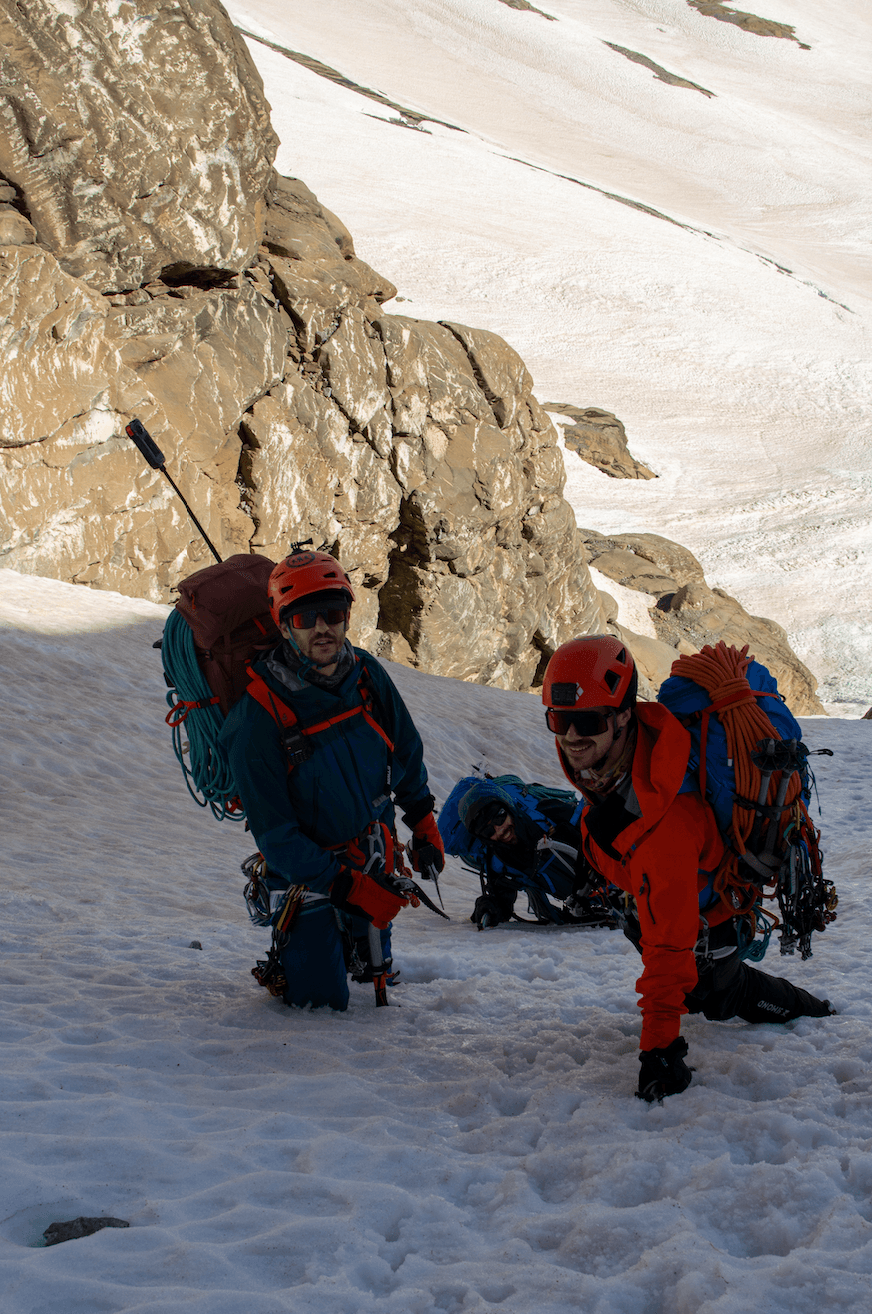
Towards the second couloir
Once the first couloir was behind us, the sun was hitting the whole slope we had to traverse to reach the entrance of the second couloir. We would pass underneath a serac, which brought the first doubt of the day: above it or below it? I had it clear. I wanted to see what it looked like up close, so below it was. You could walk upright, but the snow was already softer there, so the going became a bit heavier.

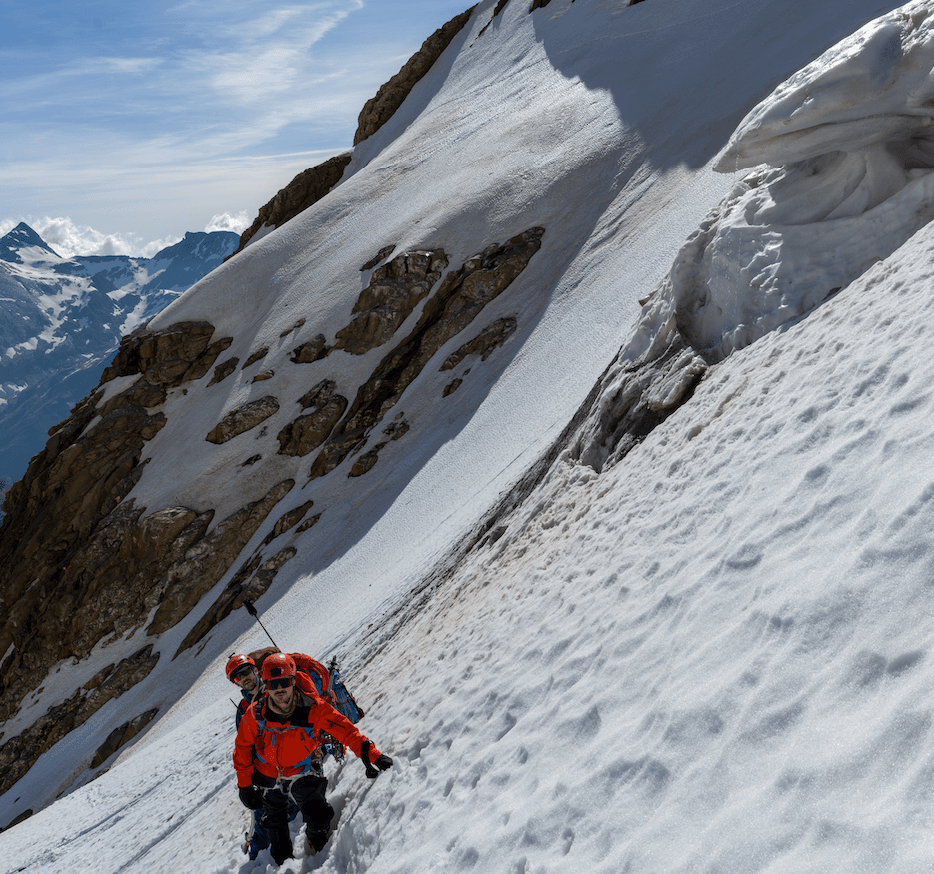
After the serac came the first tricky section. We all had it in mind that we were walking on a glacier, and that means crevasses and risk. Even though we knew the theory, none of us had ever had a real scare. That day we didn’t have that kind of scare either, but we were definitely alert. And that’s how we reached a lateral traverse, with a hole of about 4 or 5 metres underneath it, which we had to pass above. So, one by one, without stomping too hard, we crossed sideways without any problem. Finally, we were facing the last approach to the second couloir, where the angle was steeper.

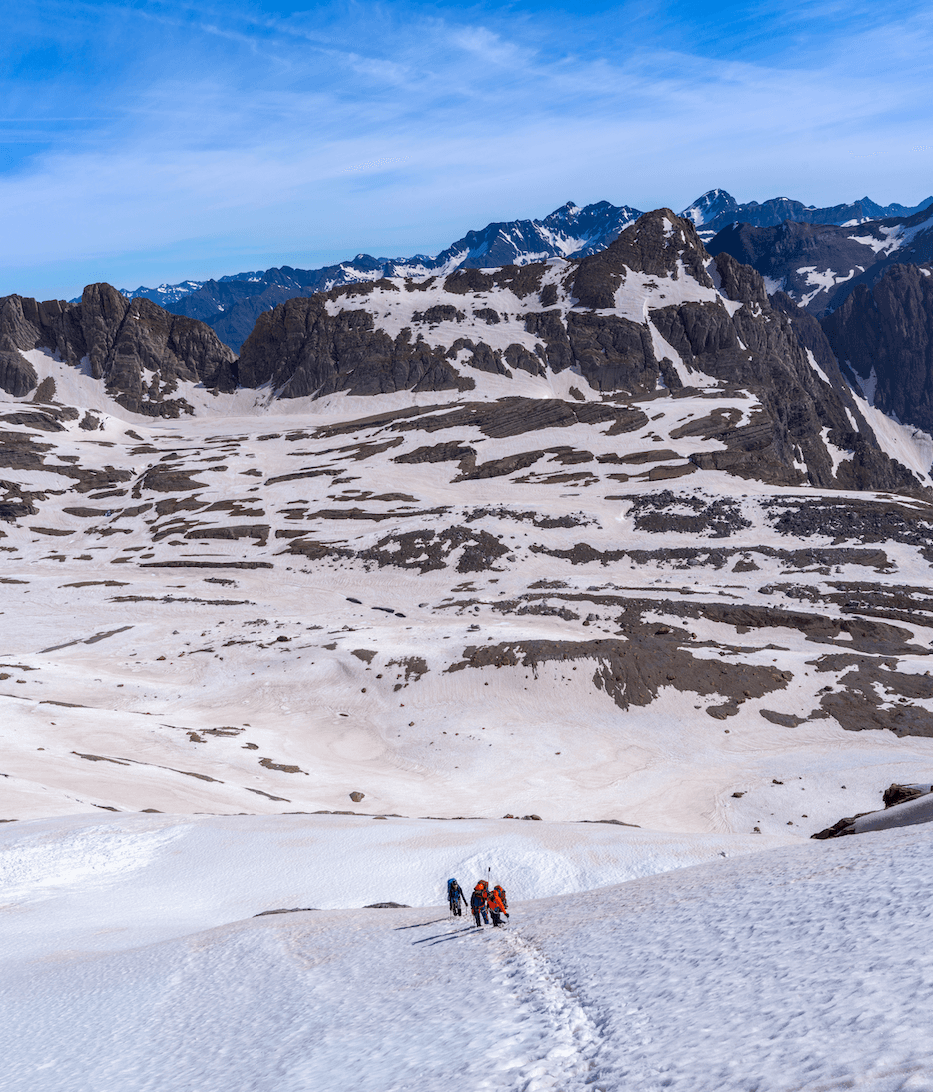

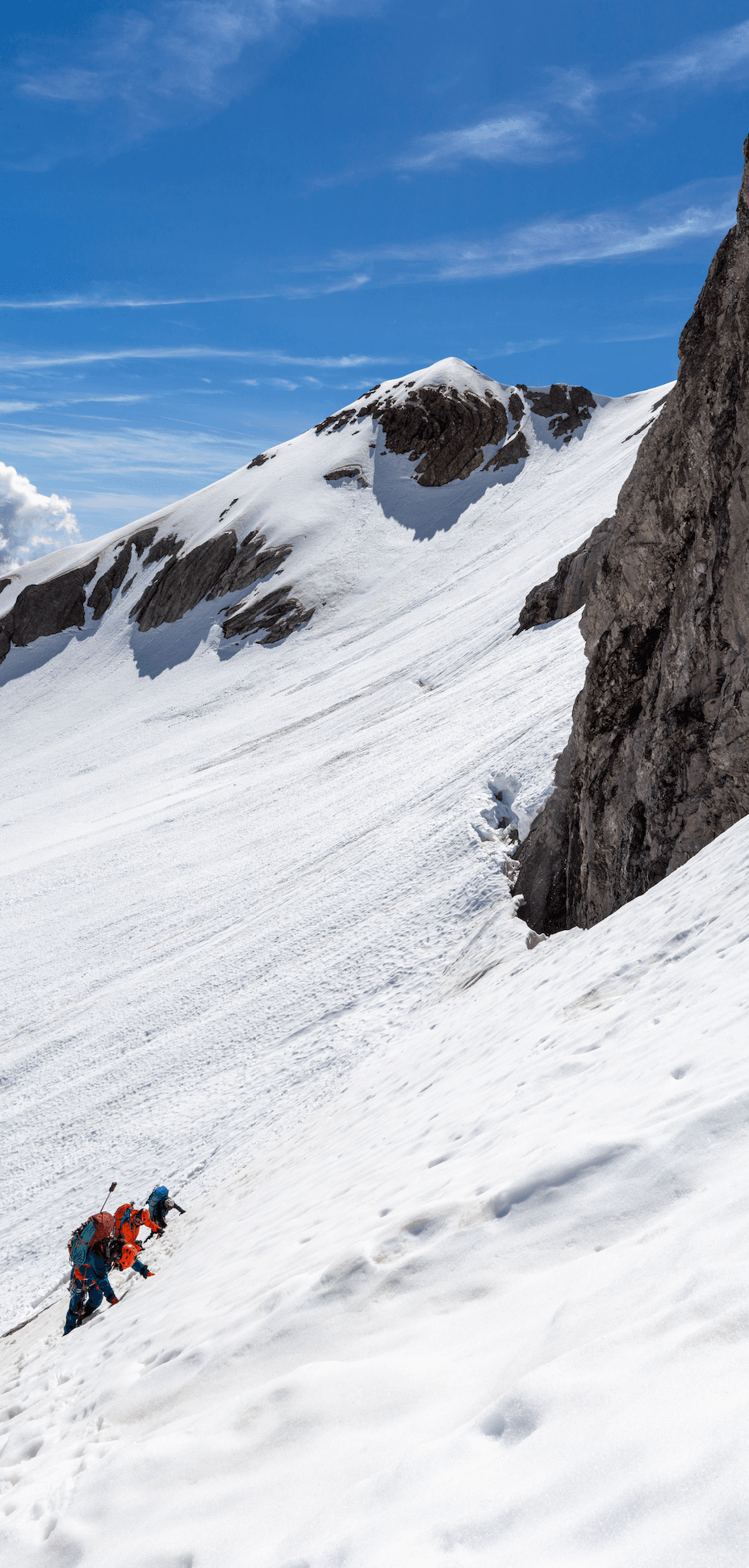
I remember the climb up this slope as harder, whether because of the tiredness accumulated up to that point, the state of the snow, or the sun beating down hard. It felt long and tedious, and while I was sweating buckets, I kept wondering how my mates could still be wearing waterproof jackets. I would have absolutely cooked myself in that much clothing. On this climb we decided to rope up in pairs. As a side note, it was the first time all four of us were above 3000 metres.
The second couloir: scares and solutions
As we climbed, we saw something that didn’t feel right, but once we reached the entrance to the second couloir, it became obvious. Where there was supposed to be a fairly complicated step, there was a meltwater waterfall. In other words, we could climb about 30 metres up the couloir, but after that there was no good snow to continue on. We had to climb somehow through the rock to bypass that section. We built an anchor with a cord around a rock bridge, and from there Joshua belayed Ernesto, while Diego and I went up to take a look and see where the hell we could go. And that’s where our own little odyssey began.

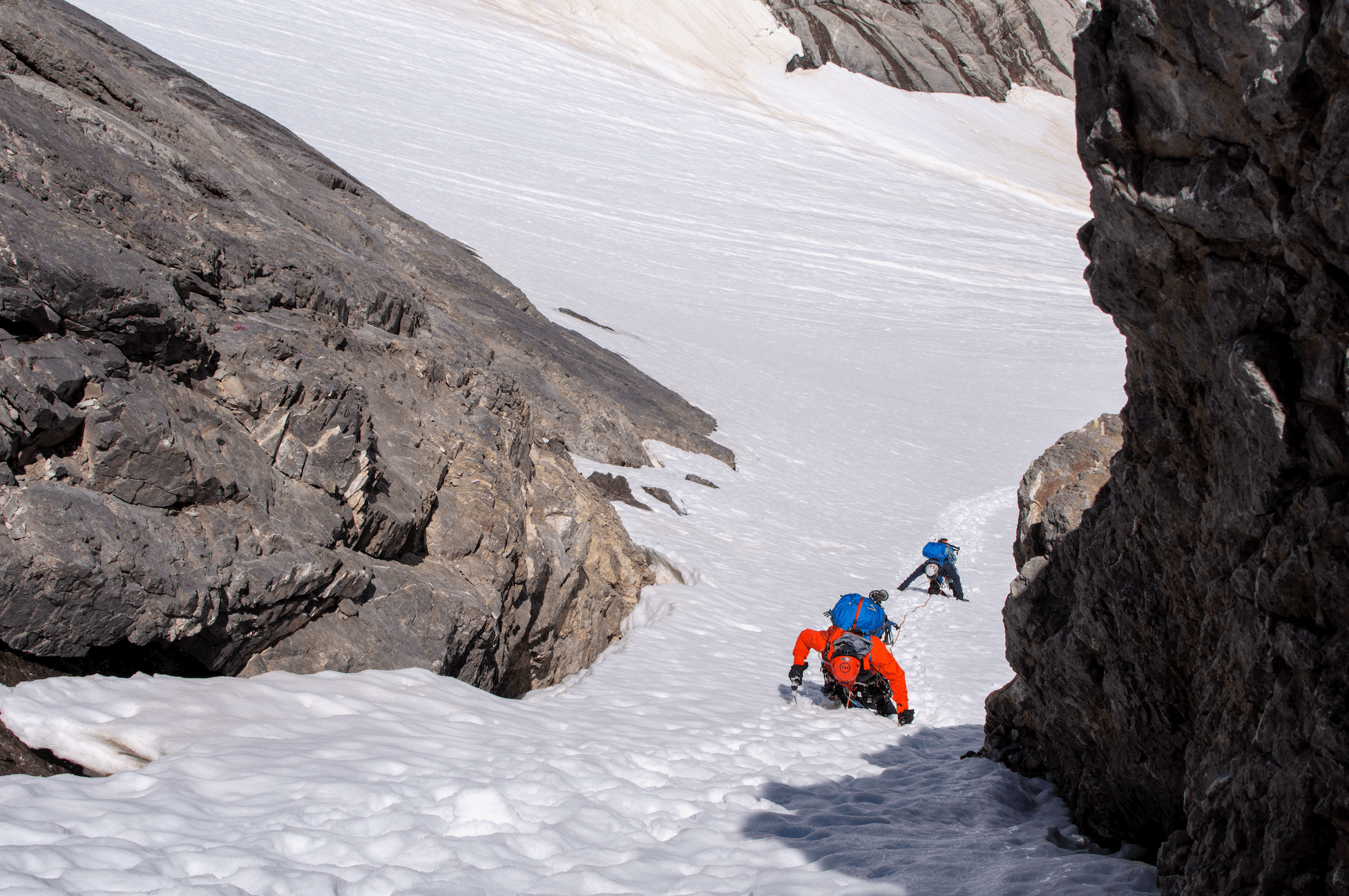
For starters, any rock you looked at too hard went straight down. It didn’t matter whether you touched it with your hands, your feet, or just breathed near it: rocks fell. We tried to climb up the right-hand side of the couloir, because the snow on the left was a soft layer of about 20 centimetres that was going to collapse under our weight as soon as we stepped on it. And that layer stopped us from reaching the left-hand side of the couloir, where we later found out the safer line was. To make things worse, there was a stream running underneath us, with all the risk that involved, so we needed to get out of that snow as soon as possible. We committed to the right, hoping to find an easy way to tell our companions below, who were waiting patiently in the shade, what to do next.

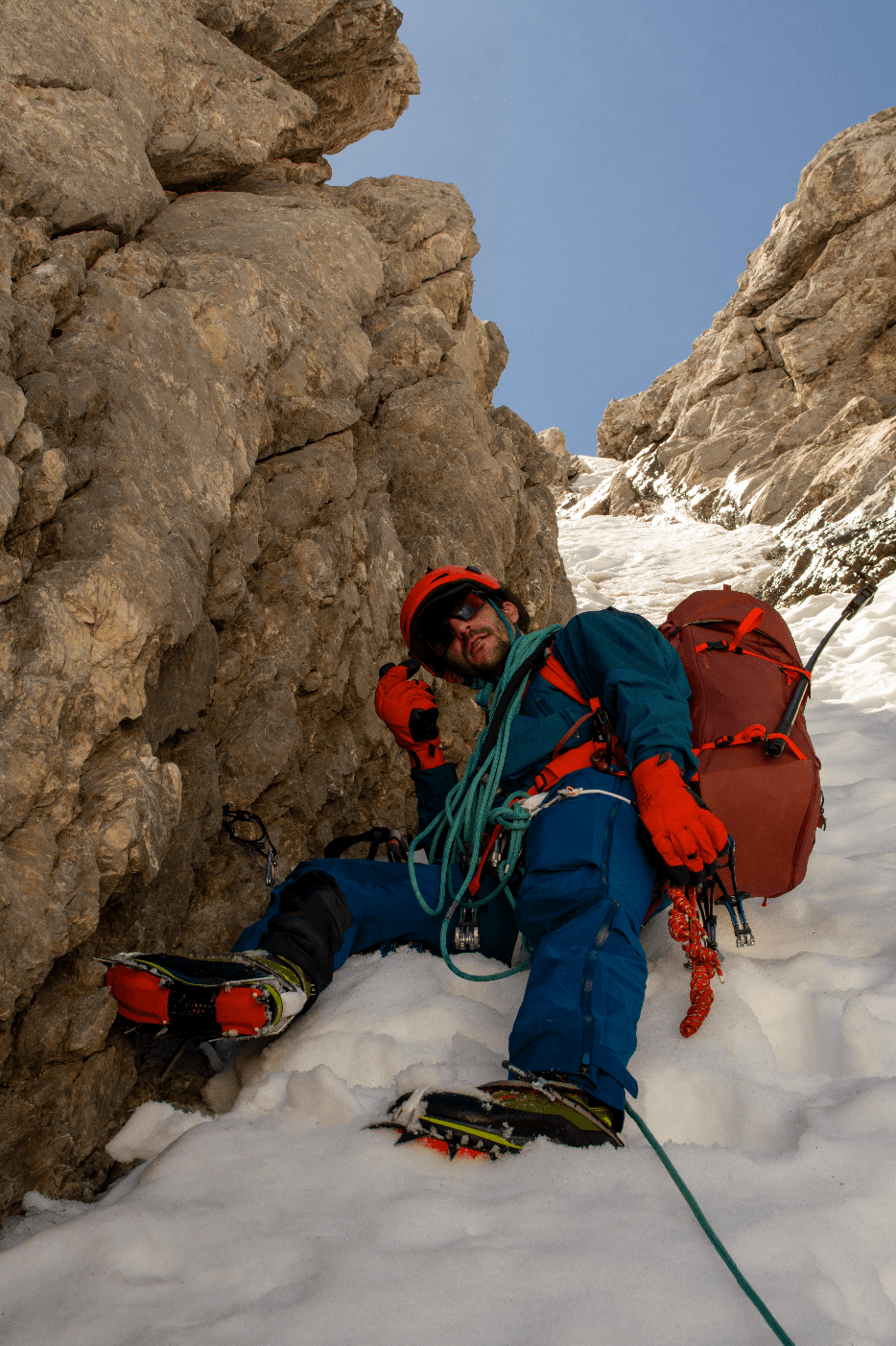
Climbing with quite a lot of difficulty, we found a ray of hope in two slings joined by a quick link, in turn attached to the wall by a piton and a spit. It looked solid, and it felt like we had made the right call. The result was that, after both Diego and I had clipped into that sling, while trying to find a way to the right along some tracks I had seen even farther over, rocks started falling — rocks I was knocking down as I moved — onto our companions below. Poor Joshua took a stone to the face, while Ernesto went full Neo from The Matrix dodging more rocks.

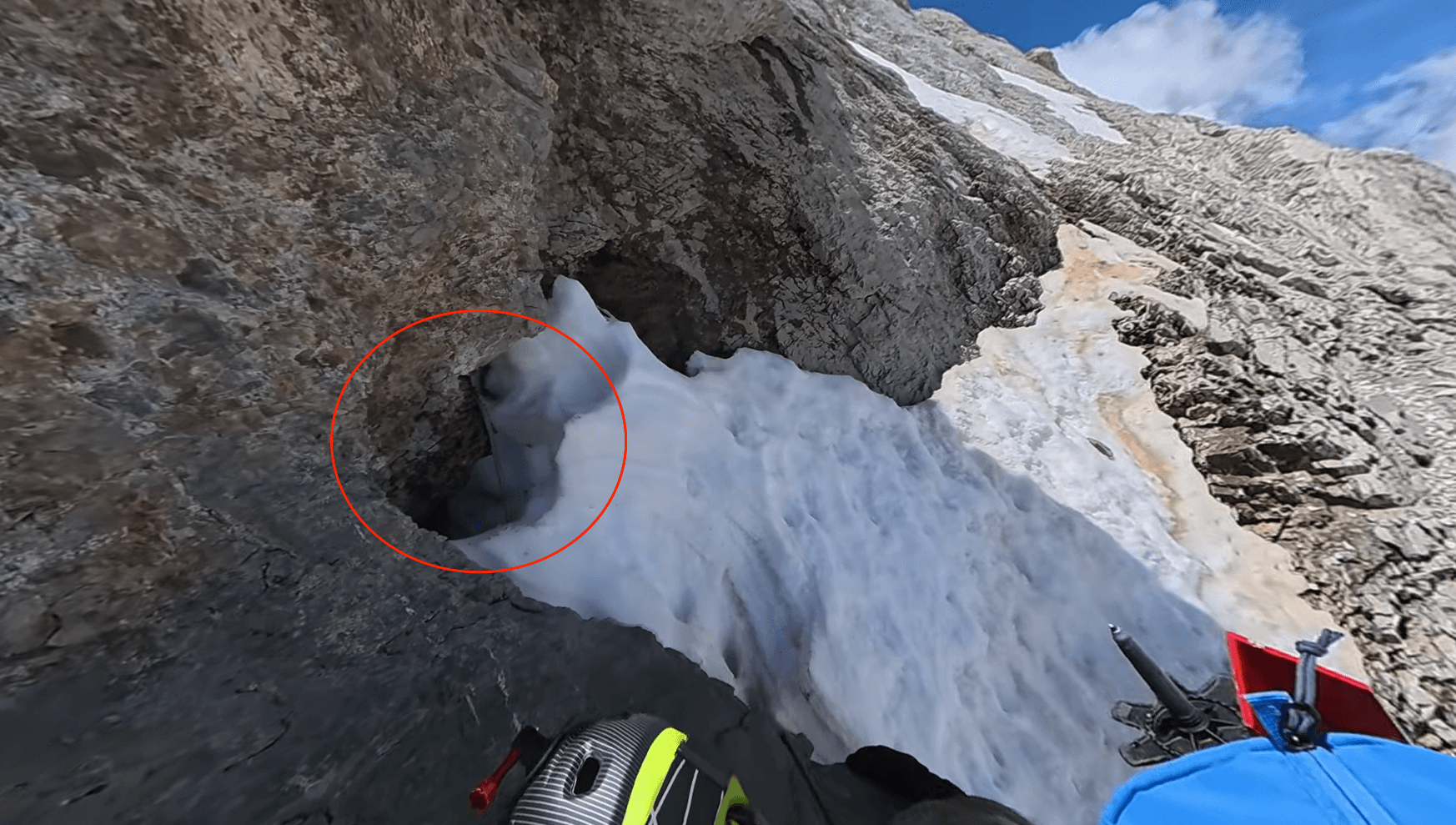
An hour that felt like an eternity
In the end, because we failed to communicate properly among ourselves, despite shouting, walkie-talkies and everything else, some people ended up freezing, others got showered with rocks, and others got stuck on the rock for about an hour that felt like an eternity. We were genuinely scared, both because of the possibility of seriously hurting our companions and because of the possibility of seriously hurting ourselves. Because, in the end, there are four of us, and we all look out for each other. And more than anything else, we all want everyone to be okay.
The retreat
We managed to get the situation under control. I returned to the sling, and from there, just by looking at each other’s faces, we knew that upward, whether there was a way through or not, was not where we wanted to go. We wanted to turn around, and that day we would not be summiting Perdido. We set up a rappel from the sling, trusting that it would hold, and began the descent back to the first anchor, where Ernesto was already shivering with cold. He had spent about an hour and a half standing still in the shade of the couloir, thinking about Caribbean beaches to see if that would warm him up.
The descent was not going to be easier than the climb. We had to retrace everything we had done, so with our faces glued to the mountainside we made our way down little by little through snow that was now much softer, while small sluffs of snow ran down the slope to our right. In our heads, the thought still weighed heavily: “Bloody hell, we came close to calling GREIM.” And in our legs, the fatigue weighed too. A slip or a bad step would mean not stopping, because the snow was already so soft that the ice axes would not have been much use. Little by little we passed the lateral traverse above the crevasse, then the serac, then headed down the first couloir… and reached the Marboré plateau, where we went to get water again.
That was the moment when, I admit it, I started crying. It’s true that I cry easily, but honestly, I was really fucking scared up there. One badly placed step could have sent down a rock that could seriously hurt my companions, as had already happened. One badly placed step could have made me fall, and even though I was roped up, I could have taken a nasty pendulum, blown the anchor, taken Diego with me, and sent us all downhill. We all knew what we were getting into, don’t get me wrong, but that doesn’t make the guilt disappear. One of Diego’s lines is staying with me forever.
We got several things wrong, but we managed to sort out our fuck-ups well.

Marboré, Tocapolla and everyone being okay
We went back for water and, after notifying Góriz shelter that we would not be arriving there for the night as planned, and after letting family and partners know that nobody needed to worry and that we were okay, we faced the last difficult part of the route: going back up to the bloody shelter, now renamed Tocapolla. Again. That horrible fucking slope of loose rock. We weren’t in a bad mood; things had already been talked through during the return, and in the end the group’s conclusion was unanimous. The four of us are okay. Full stop. That’s what matters. But climbing that slope was a proper drag. As we were almost at the top, Ernesto came out with what, for me, would be the second quote of the day.
This is my least favourite of all the shelters.
At last, we were home. The result: 13 hours on the move, going up and coming back down. Eight in the evening. Time to sort out the sleeping bags, make dinner, and talk a little about what we would do the next day, which clearly was not going to be climbing the North Couloir. Instead, we would go over the Collado del Cilindro and try to climb Perdido via the Escupidera, if the weather and snow conditions allowed it. But that would be tomorrow. Without such an early start, obviously. We fell into the shelter bunks like logs. We still had two days of the traverse ahead of us, and we kept alive the hope of summiting Perdido, this time by a safer route.
What stays with you after a day like that
I wanted this blog post to be a little less cheerful than others I have written — one — and others that will come, in case anyone ends up reading it and sees that it is not always fun. Personally, I have read lots of mountain blog posts and I often see vague comments like “there was a tricky section” or “so-and-so had a bit of a hard time”, without much detail. This is not a game. We live the mountains with passion, but at the level we sometimes move, mistakes can cost you very dearly. We lack experience, and we are learning quickly too, but I am never going to forget this day, for three reasons: because of what could have happened, because of what did not happen, and because of the joy that filled me when I saw that all four of us were okay as we started up that bloody Tocapolla climb.
Tracks, stats and videos

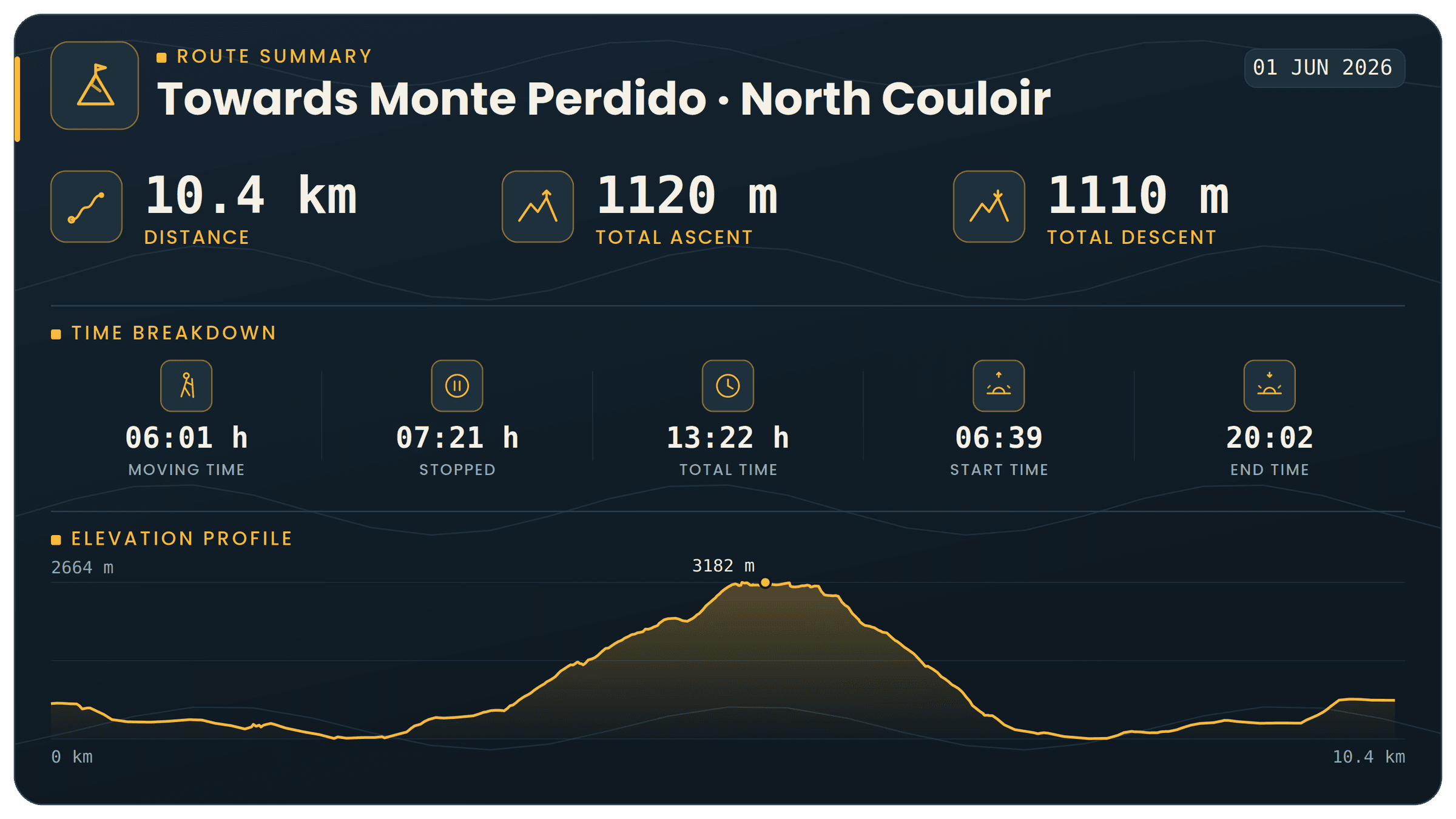
360° videos must be watched directly on YouTube — embedded players don't support interactive 360° viewing.
Watch on YouTube


